
AI Overviews are eating blog traffic: what mid-market CMS teams should do in 2026

Google AI Overviews and other answer engines increasingly summarize common questions on the results page. For mid-market marketing and ops teams on Drupal or WordPress, that can compress organic clicks on “what is / how to / checklist” style content even when the page still ranks somewhere in the mix.
This post is educational stewardship, not a doom forecast. We will not invent traffic-loss percentages. The useful question is narrower: what still earns attention and conversion when the SERP answers more of the shallow questions itself?
What is changing with AI Overviews and answer engines

Search is still a discovery channel. The job of the results page is changing.
On many informational queries, users can get a synthesized answer without opening ten tabs. Citations and follow-up links still appear, but the click is optional for people who only needed a definition, a short list, or a comparison outline.
That pattern tends to hit content that was written primarily to win a keyword, not to help someone finish a real task on your site. Thin explainers, generic “ultimate guides,” and posts that end with no next step are easy for answer engines to compress. Pages that hold unique product detail, account workflows, regulated process steps, or local/context-specific guidance are harder to replace with a generic summary.
Answer engines also raise the bar on clarity. Structured headings, unambiguous definitions, and pages that load cleanly for humans and machines matter more when a model is skimming your public HTML. Messy CMS output (duplicate titles, orphan blocks, conflicting schema, buried primary content) makes it harder for both audiences to trust what you published.
None of this means “blogs are dead.” It means blog traffic as a vanity KPI is a weaker north star than journey health, owned audiences, and pages that only you can author well.
What mid-market teams should stop chasing
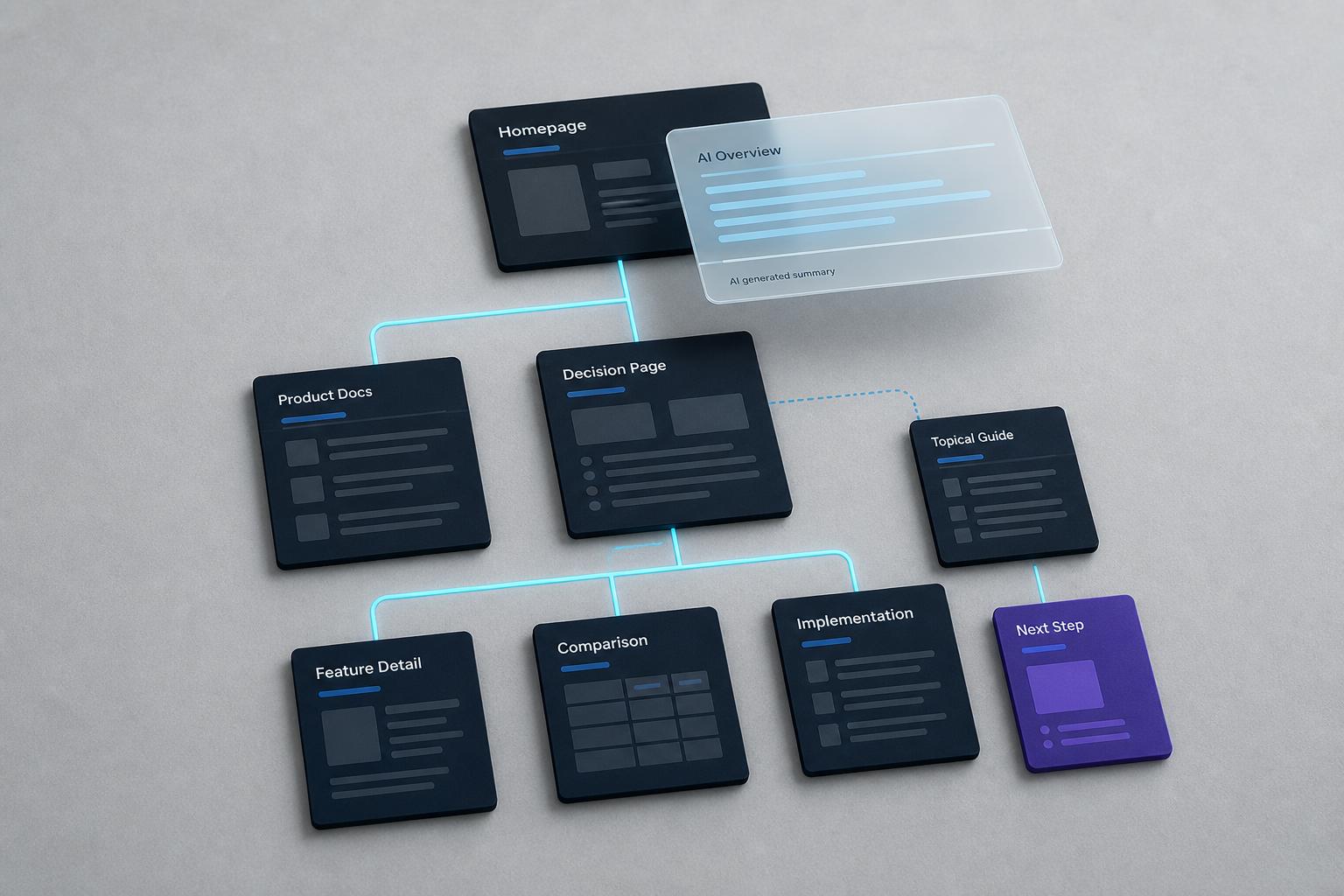
When organic clicks soften on informational queries, the temptation is to outproduce the algorithm. That usually burns budget without fixing the real problem.
Stop chasing volume for its own sake. Publishing three thin posts a week that restate what every competitor already said rarely rebuilds durable demand. Answer engines are good at summarizing consensus. They are worse at inventing your product truth.
Stop treating ranking position as the whole story. A page can still appear and still convert fewer sessions if the overview satisfied the question. Pair Search Console with engagement and conversion views on the journeys that matter (demo, contact, signup, resource download, support path).
Stop rewriting the homepage every time a SERP feature changes. Homepage theater does not replace owned distribution, email, or product documentation that people bookmark.
Stop promising “AI SEO silver bullets” inside the CMS. New plugins and modules that claim to “optimize for AI Overviews” without improving structure, accuracy, and page quality are a distraction. Stewardship beats gadget chasing.
Stop measuring success only as blog sessions. If the blog’s job is pipeline education, measure assisted conversions, email growth, and return visits from people who already know you.
What still works in 2026
Owned journeys People who already intend to evaluate, buy, renew, or get help still need your site. Make those paths obvious: clear CTAs, short forms that work on mobile, consistent navigation, and pages that answer decision questions (pricing framing, implementation shape, support model, security posture) rather than only dictionary definitions.
Email and other owned channels When search compresses cold clicks, the list you already earned becomes more valuable. Pair major articles with a useful email, not just a social blast. Invite people into a cadence that does not depend on winning every SERP feature.
Product, docs, and “only we can say this” content Release notes, implementation guides, comparison pages grounded in your actual offers, case narratives with permission, and operational how-tos tied to your product beat generic thought leadership for resilience. Answer engines may cite you; they cannot fully replace your authenticated or account-specific help.
Structured pages that serve humans and machines Well-modeled Drupal or WordPress content (clear content types, consistent fields, sensible URLs, honest titles, accessible markup) helps editors ship faster and helps crawlers and answer systems parse what you meant. Structure is not vanity SEO. It is operational clarity.
Practical CMS stewardship moves on Drupal and WordPress
You do not need a platform religion fight. You need a calmer publishing system.
- Inventory informational vs transactional URLs. Tag which posts exist mainly for awareness and which pages carry the business. Protect and improve the second group first when clicks feel soft.
- Tighten templates for the journeys that matter. On Drupal, review view modes, SDC/components, and CTA blocks on key content types. On WordPress, audit block patterns, theme templates, and plugin scripts that slow or clutter decision pages.
- Make “answerable” content accurate and scannable. Use clear H2/H3 structure, define terms once, keep dates honest, and retire or merge posts that contradict each other. Soft claims only: do not invent proof points to chase citations.
- Govern schema and metadata like product code. Duplicate Organization markup, empty FAQ fields, and auto-generated junk confuse more than they help. Prefer a small, maintained set of structured data over every plugin’s defaults.
- Connect content to CRM and email, not only to Search Console. A mid-market CMS stack earns more when publish events feed nurture, sales enablement, and support deflection, not just a traffic chart.
- Keep performance and accessibility in the same sprint as SEO. Slow, inaccessible pages lose the humans who do click through from an overview citation. Field experience still matters.
- Set an editorial bar for new posts. Before greenlighting another blog: Who is this for? What unique fact, process, or offer do we add? What owned next step do we offer if they never return via Google?
That last question alone filters a lot of low-value production.
How to talk about this internally without panic
Leadership often hears “AI ate our traffic” as a budget emergency. Reframe it as a channel mix problem.
Useful language for mid-market ops:
- Organic is still important, but informational click-through is less reliable as the only growth lever.
- We will invest in owned journeys, email, and product-true pages, not only top-of-funnel explainers.
- We will measure assisted outcomes and list health, not blog sessions alone.
- We will improve CMS structure and template quality so the pages people do visit convert and stay trustworthy.
That is stewardship. It is calmer than chasing every new SERP acronym with another plugin.
Closing
AI Overviews and answer engines change how shallow questions get answered on the results page. Mid-market Drupal and WordPress teams that keep pouring budget into interchangeable blog volume will feel the squeeze hardest. Teams that own their journeys, email, product content, and structured publishing systems still have durable ways to earn attention and action.
If you want a clear picture of how your templates, content model, and key journeys are set up for that reality, start with a site audit.