

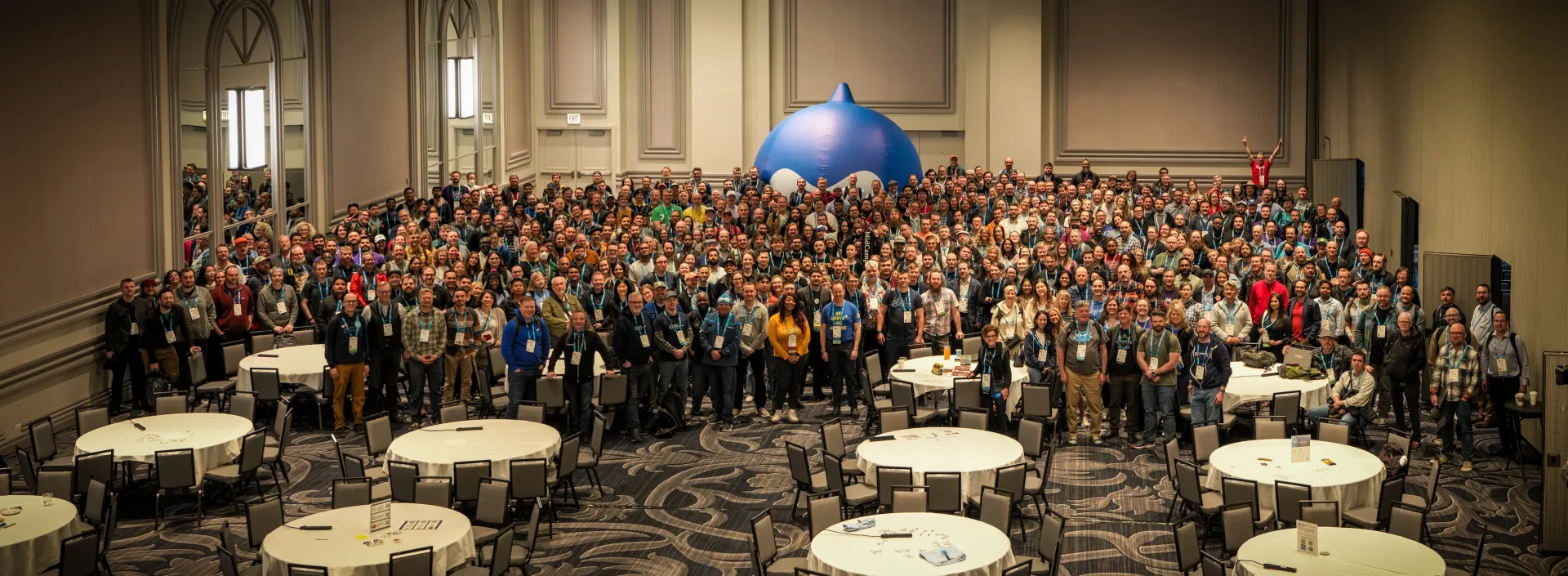

I just got back from DrupalCon Chicago 2026, and I’ve been thinking about how to describe it without sounding like every recap post out there.
This wasn’t just sessions, keynotes, and hallway conversations.
This felt like a turning point.
If you’re a developer, especially working in Drupal, you could feel the shift happening in real time. AI is no longer something we are watching from the outside. Drupal CMS is evolving in a way that is finally bridging the gap between developers, editors, and organizations. And the conversations were less about tools and more about direction.
Let me walk through it from the perspective that matters most to me: a developer thinking about the future and building real relationships.
Back to topFirst, Chicago Set the Tone
Chicago was the right city for this.
Big, active, and full of energy, but still grounded. You could step outside after a session, grab a coffee, and keep a conversation going without feeling rushed. That matters more than people think. A lot of the real value of DrupalCon happens outside the sessions (Karaoke, walk, run, birds, whatever you are into).
And this year, those conversations were different.
Back to topAI Was Everywhere, But Not in the Way You Expect
If you were expecting a bunch of “AI will replace everything” talks, that wasn’t it.
The tone was more practical. More grounded.
Developers are asking:
- How do we integrate AI into real workflows?
- How do we keep control over data?
- How do we make AI useful for editors, not just engineers?
There was a clear pattern:
AI is becoming part of the Drupal experience, not something separate.
We’re seeing:
- Content generation tools inside the CMS
- Smarter search and personalization
- AI-assisted editorial workflows
- Automation around tagging, summaries, and structure
But what stood out is this:
The Drupal community is not trying to chase AI. It’s trying to shape how AI should work responsibly.
That’s a big difference.
Especially for industries like healthcare, education, and government, where we work a lot. You can’t just plug in AI and hope for the best. You need structure, control, and trust.
Drupal is leaning into that.
Dries Keynote: AI Is Disrupting the Landscape, and That’s Okay
The keynote from Dries Buytaert hit on something every agency is feeling right now.
AI is changing expectations.
Clients want things faster.
Teams are experimenting with tools they don’t fully understand.
The line between prototype and production is getting blurry.
That can feel like a threat if you’re not ready for it.
But the message was clear:
Don’t fear AI. Learn it, shape it, and use it responsibly.
Agencies that adapt will move faster and deliver more value.
Agencies that ignore it will struggle to keep up.
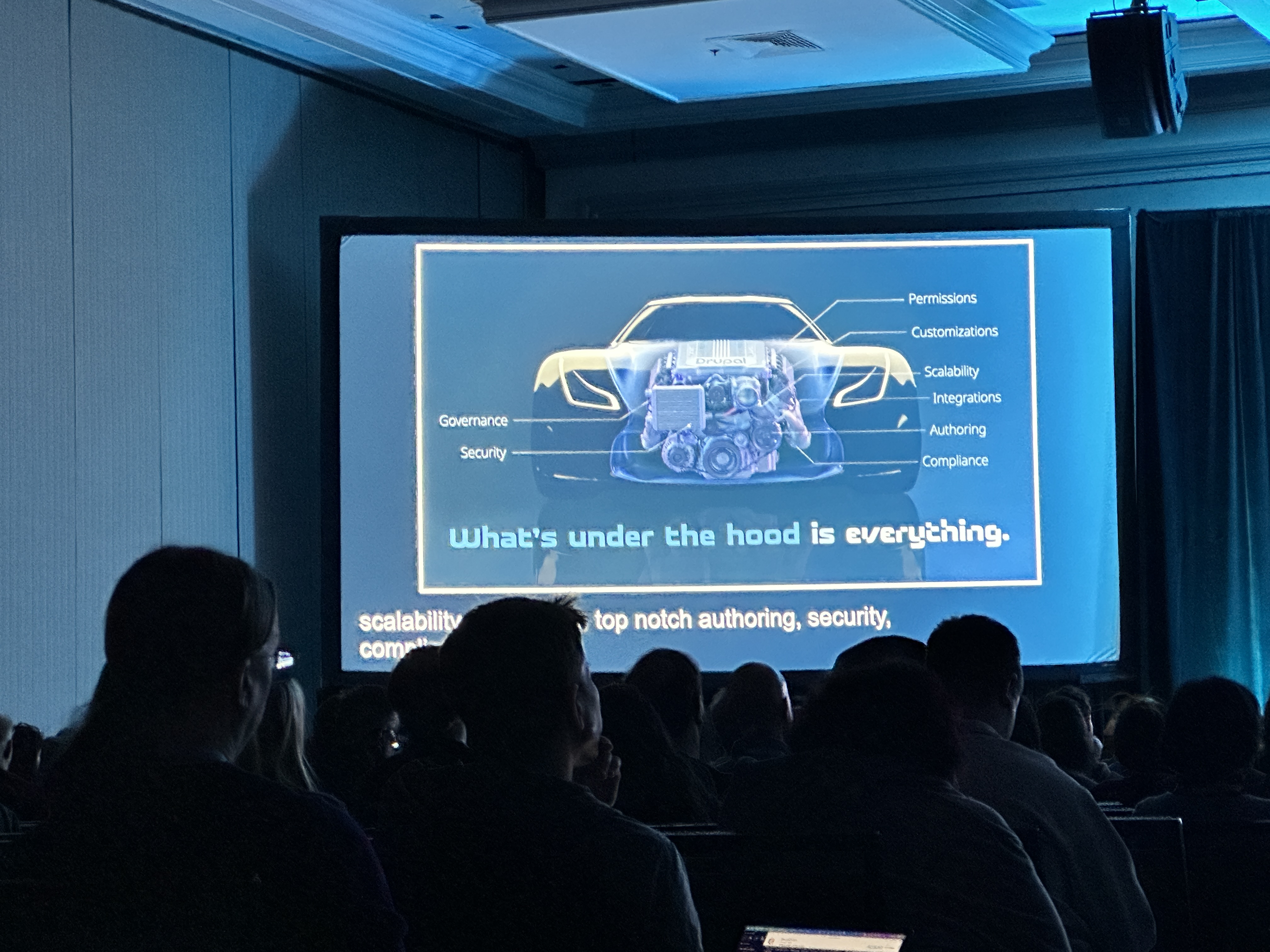
Drupal is in a strong position here because it already solves the hard part, which is structure, governance, and scalability.
AI can generate ideas.
Drupal makes those ideas usable.
Download the Keynote Slides here: Keynote Slides
Back to topDrupalCMS Is Starting to Feel Real
Over the past year, DrupalCMS has gone from an idea people were curious about to something you can actually see taking shape.
At DrupalCon Chicago 2026, it felt more concrete than ever.
Not just positioning. Not just roadmap talk.
Actual demos. Actual direction. Actual momentum.
And more importantly, a clearer understanding of where it fits.
From Concept to Direction
Early conversations around DrupalCMS were a bit unclear. People were asking:
- Is this replacing Drupal Core?
- Is this just another distribution?
- Who is this really for?
Now that’s changed.
The direction is more focused:
- Drupal Core stays the foundation
- DrupalCMS becomes the faster entry point
- Prebuilt features reduce setup time
- AI and automation are built into the experience
It’s not trying to replace what we already know.
It’s trying to make Drupal easier to adopt without losing what makes it strong.
What We’re Seeing in Practice
The demos this year made it clear that DrupalCMS is being shaped around real workflows, not just features.
A few things stood out:
Canvas AI
This is about working faster without leaving the system. Instead of jumping between tools, you can generate and shape content directly in context. It brings AI closer to how editors actually work.
Context Control Center
Managing content across different audiences and use cases has always been powerful in Drupal, but not always easy. This starts to make that control more visible and usable without heavy setup.
ECA (Event-Condition-Action)
This is where things get practical for teams. Automating workflows, triggering actions, and reducing repetitive tasks without writing custom logic every time. It lowers the barrier without removing flexibility.
The Real Value Was in the Hallways
This is where DrupalCon always wins.
You can watch all the sessions later. That’s not the main value.
The value is:
- Running into someone you worked with 5 years ago
- Meeting a new agency that complements your work
- Talking through real problems, not theoretical ones
This year, I had conversations about:
- Partnering on healthcare builds
- Supporting agencies that need stronger backend architecture
- Using Drupal in ways that go beyond marketing sites
And one thing became clear:
The ecosystem is moving toward collaboration, not competition.
Smaller agencies are teaming up with larger ones. Specialists are becoming more valuable. Relationships matter more than ever.
That’s where opportunities come from.
Back to topAI + Drupal + Real Business Needs
One of the biggest takeaways for me was how these three things are starting to connect:
- AI capabilities
- Drupal’s structured content model
- Real business use cases
For example:
- Healthcare systems needing smarter patient navigation
- Universities managing large content ecosystems
- Nonprofits trying to do more with limited resources
Drupal is in a strong position because it already handles complexity well.
Now with AI layered on top, we can:
- Reduce manual work
- Improve content quality
- Create better user experiences
But only if we build it the right way.
This is where developers still matter a lot.
AI doesn’t remove the need for architecture. It makes it more important.
Back to topThe Future Feels More Focused
In past years, DrupalCon sometimes felt like it was trying to define itself.
This year felt different.
There was more clarity:
- Drupal as a platform for complex, structured digital experiences
- AI as an enhancement, not a replacement
- Community as a real advantage, not just a talking point
And honestly, that confidence showed.
Back to topWhat This Means Moving Forward
If you’re building with Drupal today, here’s how I see it:
1. Learn AI, but stay practical
Don’t chase trends. Focus on real use cases you can implement for clients.
2. Double down on architecture
The better your structure, the more value you get from AI and automation.
3. Invest in relationships
Partnerships are becoming one of the biggest growth drivers.
4. Think beyond websites
Drupal is not just a CMS. It’s becoming part of larger systems and platforms.
My Final Thought
DrupalCon Chicago 2026 wasn’t about hype.
It was about momentum.
You could feel it in the sessions, but even more in the conversations happening in the hallways. AI is no longer something on the side. It’s part of how we think, build, and move faster. And at the same time, Drupal is grounding that speed with structure, control, and long-term thinking.
What made it stand out wasn’t just the technology. It was the people.
The conversations, the reconnecting, the new partnerships starting. That energy is what pushes everything forward.
For the first time in a while, it feels like things are lining up. AI, Drupal (Core & CMS), and the community are all moving in the same direction.
If you’re in this space, this is the moment to lean in.
Not just to what Drupal is today, but to what we can build with it next.
Back to top